



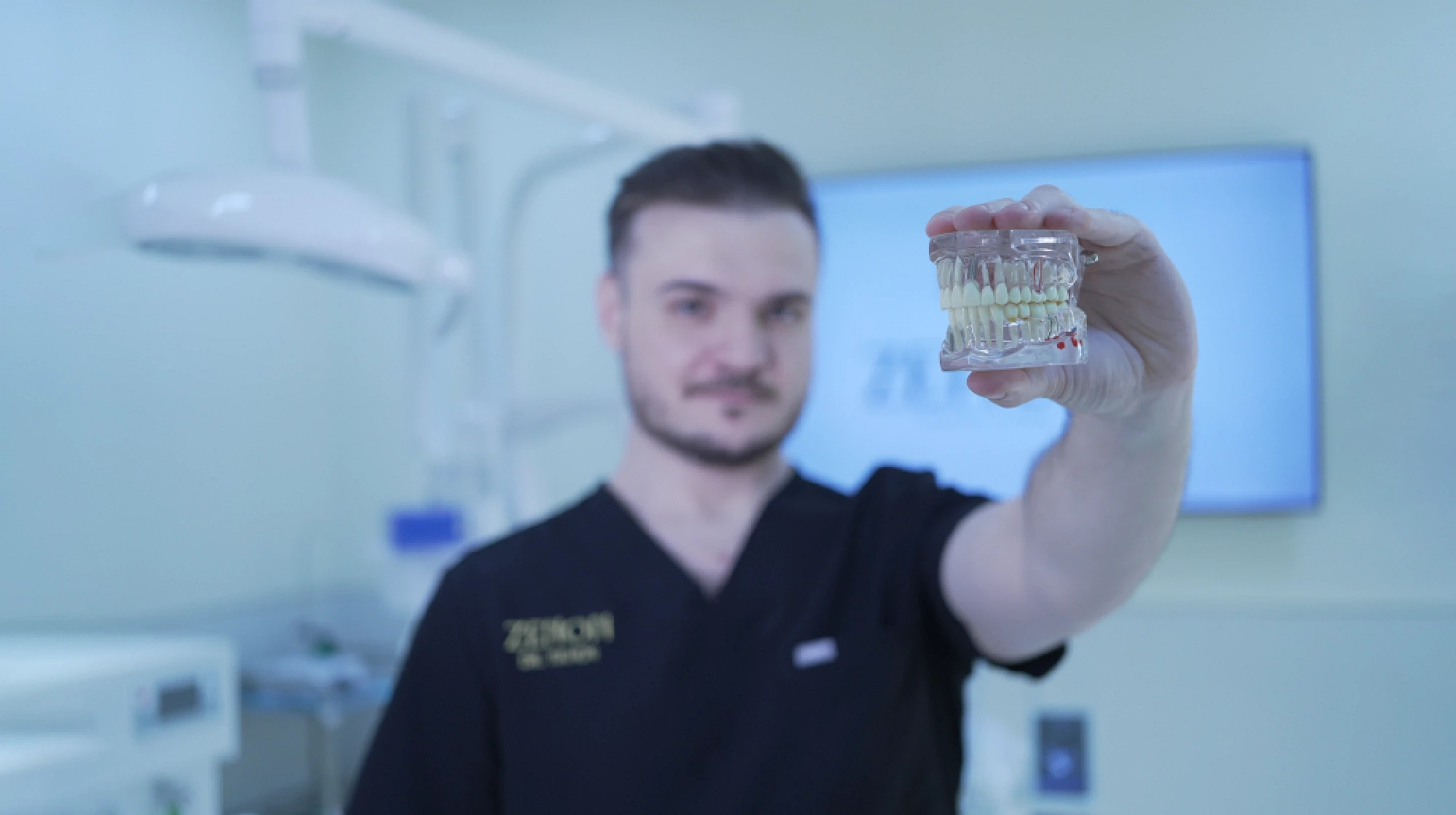
Dental Implants in Dubai
 340+ reviews
 4.9 on Google
- Experienced Russian-speaking doctors
- 0% financing available through installment plans


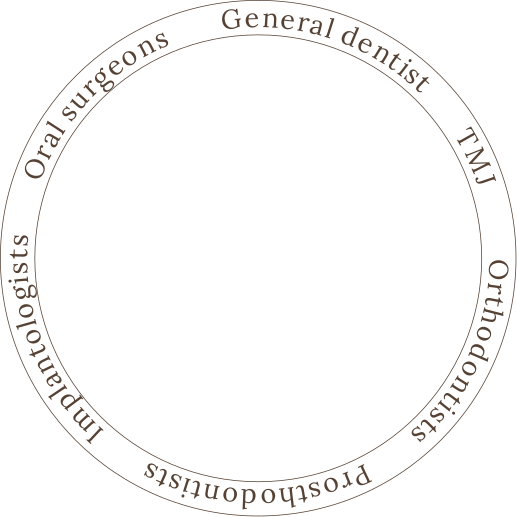
At Zenon Dental Clinic, we provide dental implants for patients missing one, several, most, or all teeth in the upper or lower jaw. Our team follows an interdisciplinary approach, carefully evaluating how the teeth align, the condition of the bite and TMJ, chewing muscle function, and the long-term plan for prosthetic restoration to ensure stable, functional, and natural-looking results.
When the implantologist, prosthodontist, orthodontist, and gnathologist work together as one team, treatment is designed to be both aesthetically pleasing and functionally stable. This comprehensive approach helps create not only a beautiful smile, but long-term oral health and balance as well.
An implantologist with over 10 years of experience in advanced restorative cases.

PhD in Medical Sciences, with more than 22 years of experience. She is a Diamond Apex Invisalign Provider and a Key Opinion Leader for SureSmile by Dentsply Sirona.

With each doctor bringing 10–20 years of clinical experience treating complex dental cases.
What Are Dental Implants?
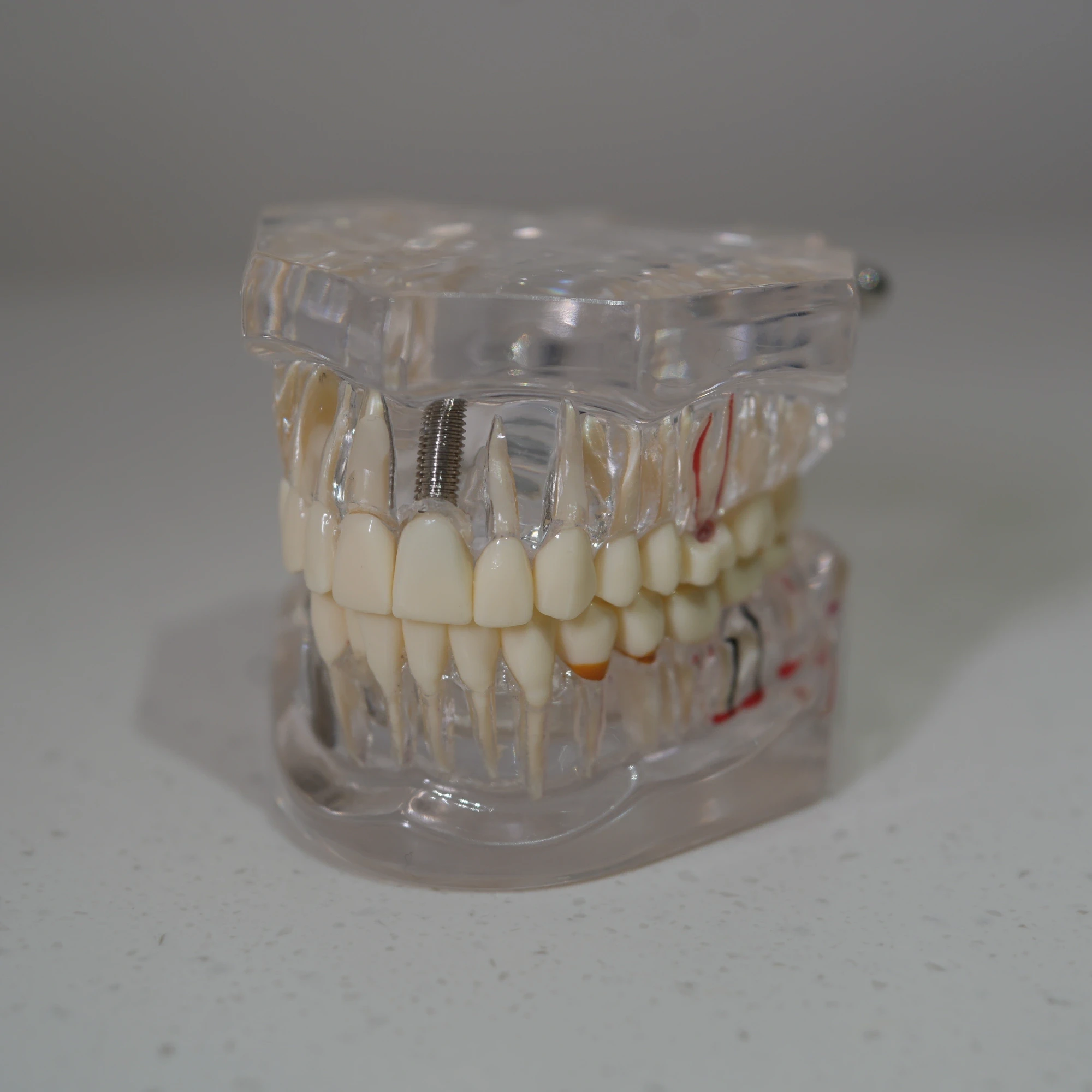
A dental implant is an artificial tooth root shaped like a small screw. It is placed into the bone in the area of the missing tooth and, after integration, becomes a reliable support for the crown.
It’s important to note: an implant and a crown are not the same thing. The dental implant itself is placed inside the jawbone and remains hidden beneath the gums. The crown is the visible part of the tooth attached to the implant, designed to restore the appearance, shape, and chewing function of a natural tooth. It is the part patients see when they smile and use while eating.
At Zenon Dental Clinic, we work with proven implant systems — primarily titanium implants by MegaGen (South Korea) and Straumann (Switzerland), which have proven themselves in terms of reliability and long-term results. We also place Straumann zirconia implants. The choice between titanium and zirconia implants is determined after a comprehensive evaluation, taking into account the condition of the bone and soft tissues, the implant location, expected bite нагрузка, and the long-term prosthetic treatment plan.
Pricing
MegaGen implants — 3000 AED
Straumann implants — 4000 AED
Bone grafting — from 4000 to 6000 AED
Gum grafting — from 1500 to 3000 AED
Advantages of Dental Implants
Unlike a traditional bridge, implant placement does not require grinding down neighboring teeth and turning them into supports. This is especially important if adjacent teeth are healthy: implants help preserve their tissues and restore teeth in the most physiological way possible.
Dental implants restore not only the appearance of a smile, but also full chewing function. After a crown or bridge is placed on the implants, patients can comfortably chew, speak, and smile again. Proper treatment planning is essential and includes evaluating the bite, load distribution, TMJ health, and chewing muscle function to ensure long-term stability and comfort.
Implants can be used in cases of loss of one tooth, several consecutive teeth, or full jaw rehabilitation. Depending on the clinical situation, the doctor may recommend one implant with a crown, several implants supporting a bridge, or full restoration of the entire dental arch.
With advanced diagnostics, precise implant placement, properly planned prosthetics, and consistent care, dental implants can last for many years. Long-term success depends not only on the surgical procedure itself, but also on balanced chewing load and overall bite function. That is why at Zenon Dental Clinic, implant treatment is planned as part of a complete oral rehabilitation approach — taking into account future prosthetics, bite alignment, and the health of the entire dental system.
There are certain absolute contraindications to dental implant placement when surgery is impossible (see the list of absolute contraindications below).
Doctor’s Insight
Orthodontist with over 22 years of experience
Reviews
340+ reviews, 4.9 on Google Maps
See all our reviews22 Apr 2025

30 Mar 2025
29 Jun 2025
23 Jul 2025
12 Aug 2025
20 Jan 2026
10 Dec 2025
28 Feb 2026

Our Approach
At Zenon Dental Clinic, we view implant placement as part of the overall function of the entire dental system, not as an isolated procedure. Before treatment, we evaluate the bite, jaw position and movement, the condition of the TMJ and chewing muscles, bone volume, and the expected load on the future crown, bridge, or full-arch restoration.
Our goal is not simply to replace a missing tooth, but to integrate the implant and restoration into the dental system in a way that allows the patient to chew comfortably while helping prevent overload of the chewing muscles and temporomandibular joint. In more complex cases, treatment may begin with functional diagnostics and a preparatory therapeutic stage if needed.
A successful implant result is about more than just matching the shade of a crown. The restoration must also have the proper shape, height, position, and material to harmonize naturally with the surrounding teeth while supporting the function of the entire dental system.
At Zenon Dental Clinic, we focus on results that are both natural-looking and functionally stable. The material and design of each restoration are selected individually based on the smile zone, chewing load, bite condition, and the patient’s overall clinical situation.
We understand how important it is for the patient not to be left without a tooth during treatment, especially in the smile zone. That is why, even during the planning stage, we discuss temporary solutions such as a temporary crown, temporary bridge, adhesive restoration, or a transparent aligner with a temporary tooth.
If the implant is stable enough immediately after placement, a temporary crown can be attached to it. If this option is not safe, we choose another temporary solution to maintain aesthetics and comfort until the final prosthetic restoration is completed.


Book a Consultation
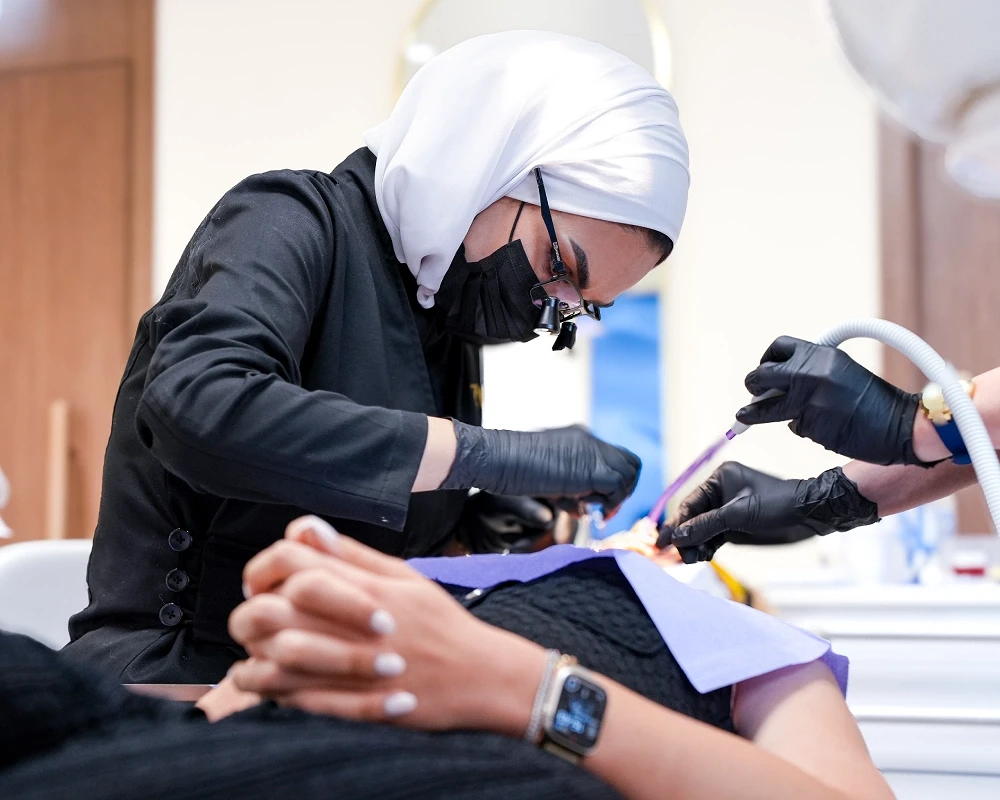
Consultations are conducted by doctors with 10–20 years of experience. Comprehensive diagnostics, including CBCT, and a personalized treatment plan — all in one visit.
 Meet Our Doctors
We will match you with the right specialist: orthodontist, general dentist, or surgeon.
 +971 4 286 7747
Write to us on WhatsApp or call us
within 15 minutes
 Complex cases are handled by Dr. Nana, an Invisalign speaker in Dubai
get the rest free.
How the First Implant Consultation Takes Place
The initial consultation is needed not only to answer the question, “Can an implant be placed?” Its purpose is to understand what the future tooth or prosthetic restoration should look like, how it should function during chewing, and which treatment stages are needed for a stable, long-lasting result.
During the consultation, the doctor evaluates the condition of the teeth, gums, bone tissue, bite, and future prosthetic area. After diagnostics, the patient receives a clear treatment plan: how many implants may be needed, whether preliminary treatment is required, whether a temporary restoration is possible, and what the final result may look like. The patient also receives information about the cost of treatment.
For patients with increased anxiety or fear of dental treatment, implantation can be performed under sedation. This is a medically induced sleep that allows the patient to feel relaxed, avoid stress, and comfortably tolerate the procedure. The anesthesia and sedation options are discussed individually during the consultation..
Cone-beam computed tomography is a 3D scan of the jaws that helps the doctor evaluate the volume and quality of bone tissue, the location of important anatomical structures, the condition of adjacent teeth, and the most accurate position for the implant. This type of diagnostics is especially important because the implant must be placed not simply into the jawbone, but in the correct position for the future crown, bridge, or full-arch restoration.
At Zenon Dental Clinic, digital diagnostics are a mandatory part of our comprehensive approach to implantation and prosthetics. Our CBCT machine allows us to obtain highly accurate images of the dental system, TMJ, skull, and cervical spine with minimal radiation exposure. There are only two such CBCT machines in the UAE: one is installed in our clinic, and the second is located at the University of Sharjah.
During the consultation, we perform intraoral 3D scanning — a digital impression of the teeth without traditional molds. This helps us accurately plan the future crown, bridge, or fixed full-arch restoration, evaluate tooth contacts, and understand how the chewing load will be distributed after implantation.
If the patient requires full rehabilitation, has severe tooth wear, TMJ complaints, muscle tension, or signs of overload, extended functional diagnostics may be necessary. This may include axiography and other methods used to evaluate lower jaw movement and chewing muscle function.
This allows us to understand in advance how the future restoration should function and helps prevent situations where the new teeth look beautiful but cause discomfort or overload during chewing.
Stages of Dental Implant Treatment
Dental implantation does not follow one universal protocol for every patient. The number of stages depends on the clinical situation: how long the tooth has been missing, whether extraction is needed, whether there is enough bone tissue, whether a temporary restoration can be placed immediately after surgery, and whether the treatment involves a single missing tooth or full rehabilitation of a completely edentulous jaw.
At the first stage, we perform CBCT, digital intraoral scanning, and a photo protocol. If necessary, functional diagnostics are added — for example, when there are TMJ complaints, severe tooth wear, or signs of chewing muscle overload. After diagnostics, the doctor evaluates the possible treatment options and explains which approach is most appropriate for your specific case.
During this visit, we discuss the future treatment plan in detail: how many implants are actually needed, which prosthetic structure will be optimal, whether a preparatory stage is required, and whether a temporary solution is possible immediately after surgery. The patient also receives a clear understanding of the treatment timeline, stages, and expected prognosis. It is important that even before the surgical stage, we understand what the final prosthetic result should look like.
Under local anesthesia, with sedation available if needed, the implant is placed into the bone in a pre-planned position — taking into account the future crown, bridge, or full-arch restoration. In some cases, implantation can be performed immediately after tooth extraction. However, the decision to place a temporary crown is made only after evaluating the primary stability of the implant: it is important that the temporary structure does not create excessive load.
If clinical conditions allow, a temporary crown can be fixed onto the implant immediately after placement. If this option is unsafe, we select another temporary solution: a temporary bridge, adhesive restoration, or a transparent aligner with a temporary tooth. Our goal is to preserve aesthetics and comfort during the implant integration period.
After the implant integrates with the bone, a permanent crown, bridge, or fixed full-arch restoration is fabricated. At this stage, the precision of the shape, height, contacts with neighboring teeth, and chewing load distribution are especially important. If necessary, a try-in is performed, adjustments are made, and only after that is the final restoration fixed in place.
After treatment is completed, the patient remains under the doctor’s supervision. Follow-up examinations and professional oral hygiene help monitor the condition of the gums, bone tissue, implant, and prosthetic structure. This is an important part of achieving a long-term result, because the lifespan of implants depends not only on placement, but also on regular care and professional maintenance.
Our Interdisciplinary Approach
Reviews
Chosen by Patients Who Value Exceptional Care
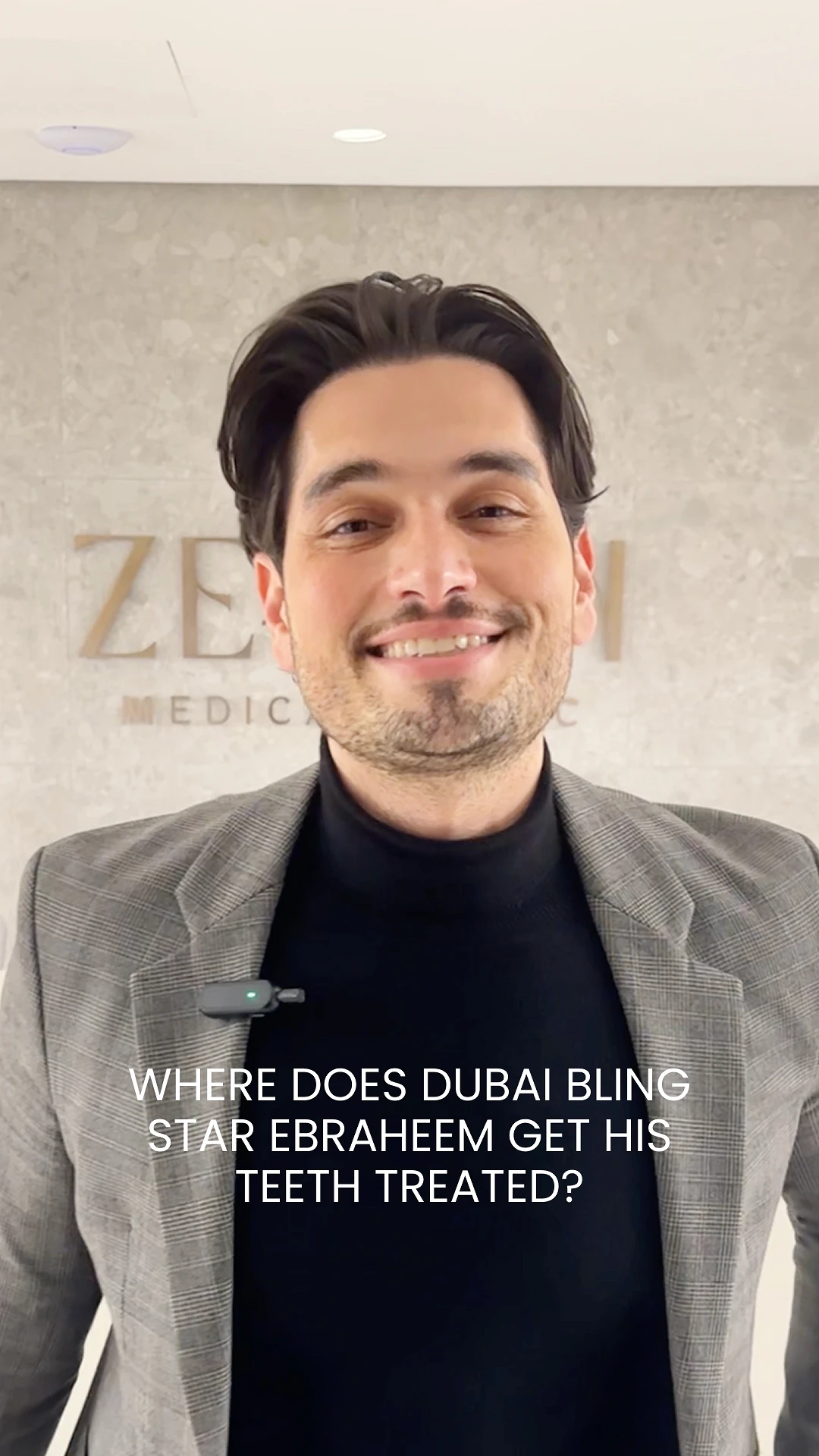
Among our patients are public figures, executives, and international professionals who value exceptional quality, confidentiality, and a premium standard of dental care.

Dental Implantation According to International Standards
Proper implantation begins not with surgery itself, but with detailed diagnostics and treatment planning. We evaluate bone volume and quality, tooth position, bite alignment, chewing muscle function, and, when necessary, the condition of the TMJ. This comprehensive approach helps us understand in advance where the implant should be placed and how the future restoration will function within the entire dental system.
Before treatment begins, we determine what the final prosthetic restoration will be — whether it is a single crown, bridge, or full-arch rehabilitation. For us, it is important that implants are placed not simply where bone is available, but in the correct position for the future prosthetic structure. That is why each treatment plan is created individually, taking into account function, aesthetics, bite balance, the clinical situation, and the long-term prognosis of the result.
Our goal is not simply to replace a missing tooth, but to create a result that functions comfortably and predictably every day. Functional planning helps reduce the risk of overload on the implants, prosthetic restorations, chewing muscles, and TMJ, while also lowering the risk of discomfort and long-term complications. That is why we focus not only on the surgical stage, but also on bite function, load distribution, prosthetics, and long-term follow-up care.
Indications and Contraindications
Dental implants may be recommended in cases of:
- Missing one tooth
- Missing several consecutive teeth
- Complete absence of teeth
- The need to replace a failed bridge or an uncomfortable removable denture
Additional preparation before implantation may be required if the patient has:
- Gum inflammation
- Significant bite disorders
- Bone tissue deficiency
- Bruxism (teeth grinding)
- TMJ complaints
- Untreated dental conditions
Implant treatment may not be recommended in certain medical situations, including:
- Blood clotting disorders
- Uncontrolled diabetes mellitus
- Autoimmune diseases during active exacerbation
Prevention and Long-Term Care
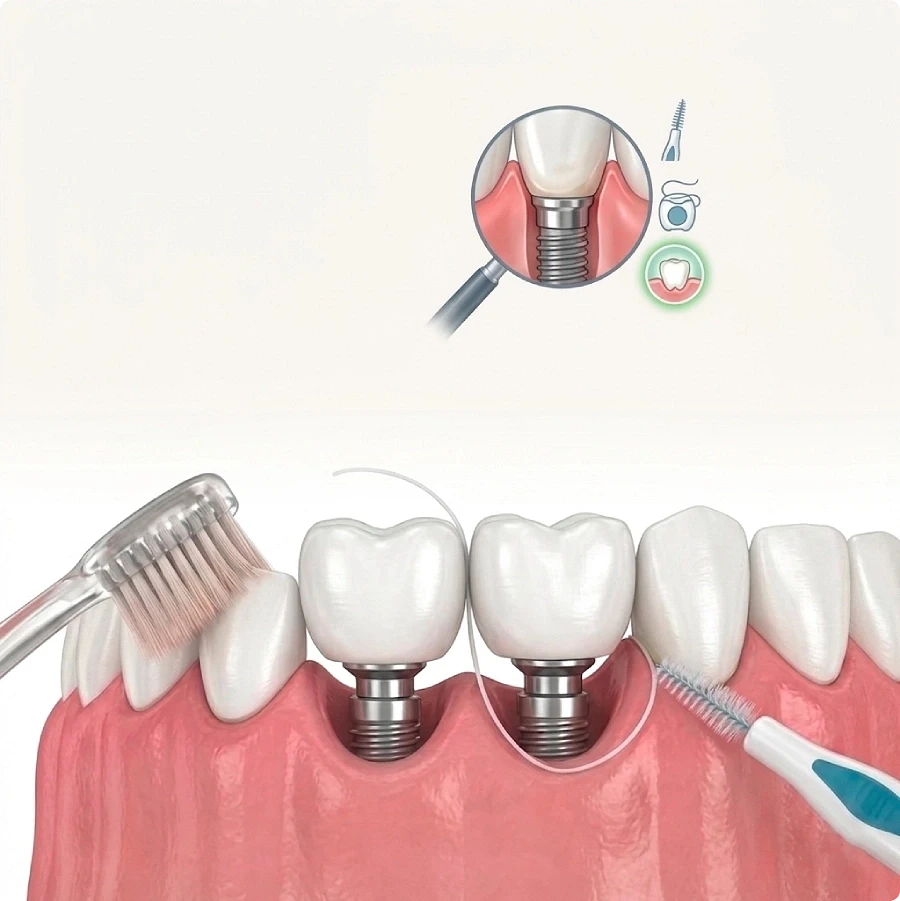
After implantation, it is important not only to allow the implant to integrate properly, but also to maintain it with consistent long-term care. During the first days after surgery, patients should carefully follow the doctor’s recommendations: maintain gentle oral hygiene, avoid excessive pressure on the surgical area, follow the recommended diet, and allow the tissues to heal properly. This helps reduce the risk of postoperative complications and supports healthy recovery.
Once the implant has integrated with the bone, the foundation of long-term maintenance becomes high-quality daily oral hygiene. Teeth should be brushed twice daily, and the spaces between the teeth and around the implant should be carefully cleaned using products recommended by the doctor. Preventing plaque accumulation near the gum line is especially important because inflammation around implants most often begins in this area.
Even with excellent home care, implants — like natural teeth — require regular professional examinations and hygiene appointments. During follow-up visits, the doctor evaluates the condition of the gums and bone tissue, the stability of the implant and restoration, the quality of oral hygiene, and how the structure tolerates chewing load over time. Regular monitoring helps identify changes early and maintain stable long-term results for many years.
Frequently Asked Questions
Will it hurt?
How long does recovery take?
Is one implant always needed for one tooth?
Can a temporary tooth be placed immediately?
Can an implant and a natural tooth support the same bridge?
Do you make permanent implant crowns in one day?
Zenon Dental Clinic on the Map
We are always happy to welcome you!
247 Jumeirah St – Jumeirah – Jumeirah 2 – Dubai

A calm, welcoming space where every detail is thoughtfully designed.
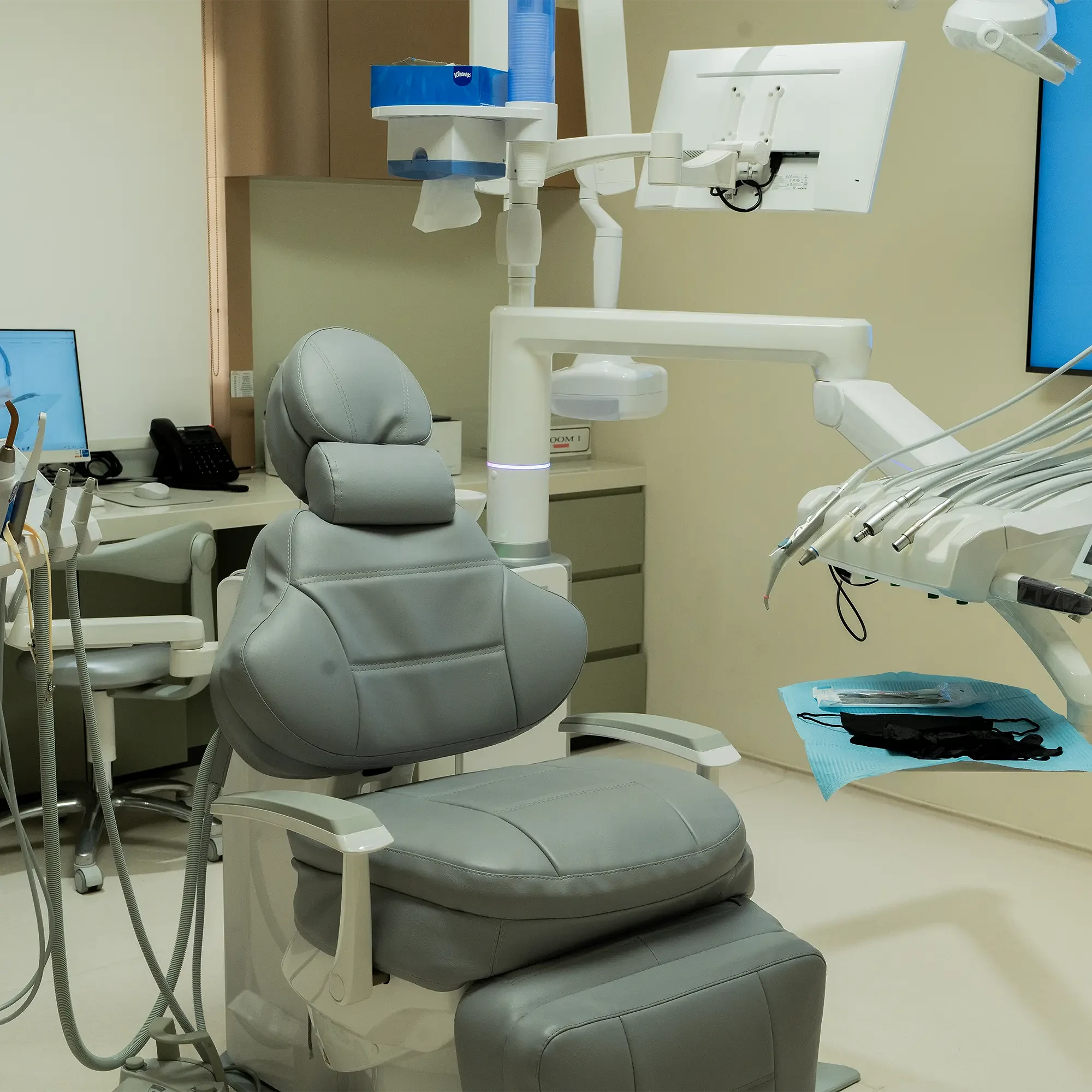
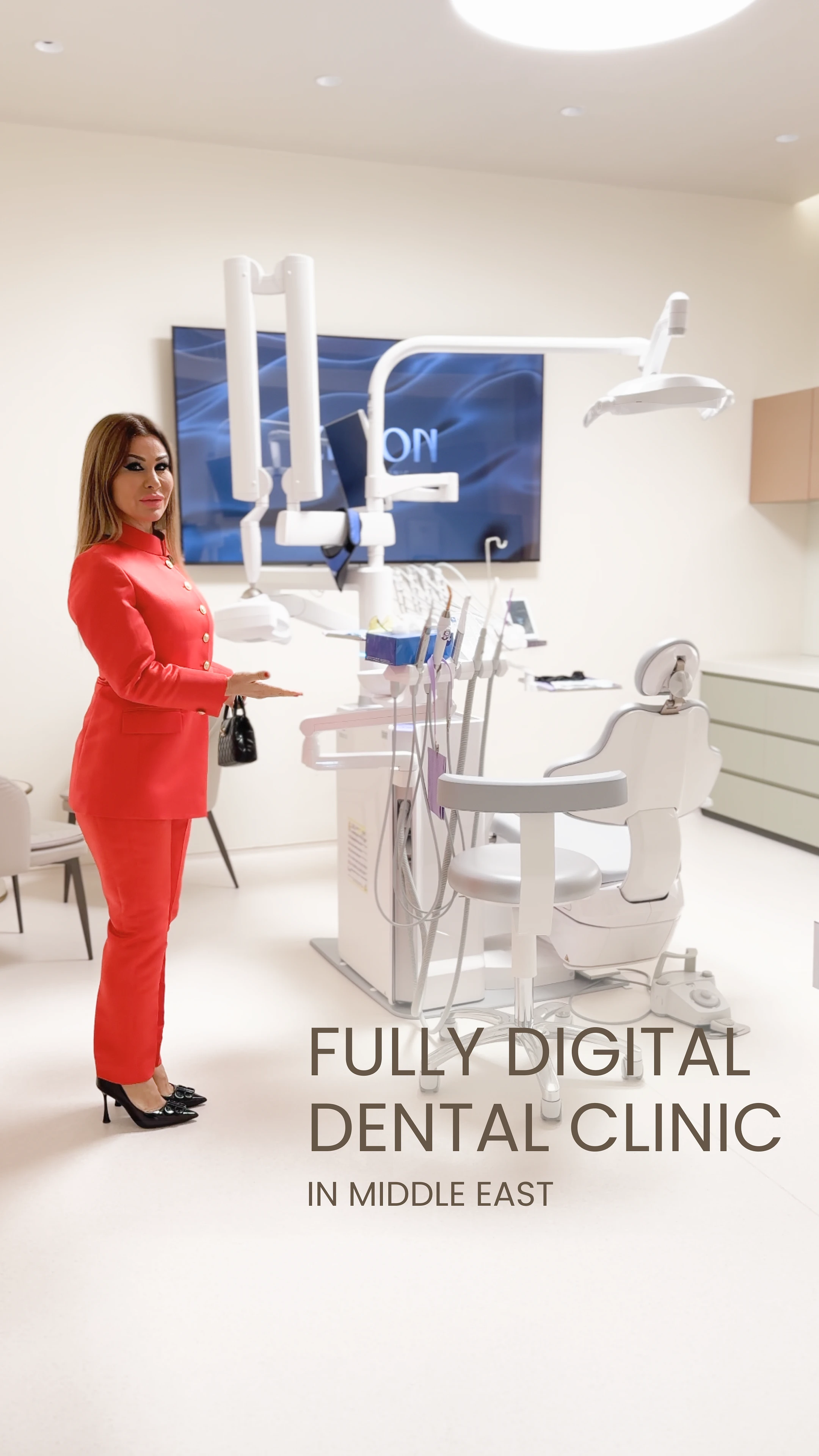
Equipped with the latest digital diagnostic and treatment technology.